

Munich, March 20, 2026
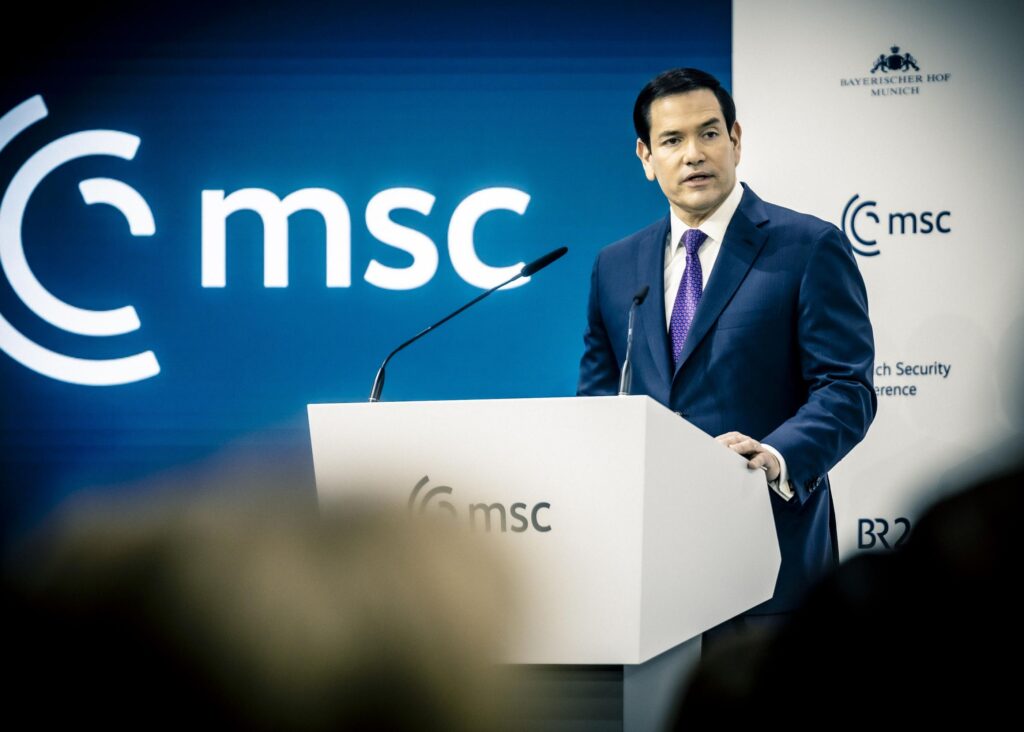
Bildquelle: MSC, Kuhlmann
Five centuries of colonial expansion as a success story, standing ovations in the hall – the Munich Peace Conference warns against the return of colonial thought patterns and the erosion of international law.
Great relief in the hall during US Secretary of State Marco Rubio’s speech at the Munich Security Conference (MSC) in February. European politicians applaud the Trump administration’s commitment to the transatlantic partnership.
Rubio received a standing ovation for his historical narrative of the Western success story of five centuries of colonial expansion: “For five centuries, until the end of the Second World War, the West was expanding. Its missionaries, its pilgrims, its soldiers, its explorers poured out from its shores – across oceans – colonizing new continents, building vast empires that stretched across the globe,” said the American Secretary of State.
For Maria R. Feckl, M.A., Director of the Munich Peace Conference, this narrative fails to include the brutal reality of colonial history: genocide, enslavement, land theft and the systematic exploitation of entire continents. Millions of people were disenfranchised or killed, cultures destroyed and societies subjugated. According to Feckl, Rubio wants to send a clear political signal. Critics see this historical narrative as a trivialization and political rehabilitation of colonial violence.
Munich Security Conference as a stage for Western power politics
According to the head of the peace conference, it was no coincidence that the speech was given at the MSC of all places. Every year, heads of government, military leaders, arms companies, think tanks and lobby organizations meet there to discuss the strategic future of international politics. Critics have long described this meeting as part of a “privatized world politics”. Journalist Wolfgang Michal writes in der Freitag of 12.02.2026 of a “class reunion of the extended West” at which political and economic elites discuss global power issues behind closed doors.
While international institutions such as the UN or the OSCE are losing influence, an informal network of political and economic elites meets here and discusses global power issues outside of democratic decision-making structures and legitimacy. For the MSC, this has become the norm. It has the advantage that Western power and civilization policy – and the interests of the arms industry – merge more closely in so-called backroom talks.
In view of this undemocratic development, it is all the more disconcerting that Rubio is being celebrated with a standing ovation. At this private forum of the transatlantic security policy elite, which is also supported with considerable public funds, a speech is celebrated in which five centuries of colonial expansion are praised as part of Western greatness.
Marco Rubio’s speech and the return of colonial narratives
Rubio’s speech follows a logic that has become increasingly important in recent years: the idea of a threatened “West”. This appears as the only true civilization – linked by history, culture, religion and shared values. This civilization must be defended: against geopolitical rivals, against migration – often also a consequence of Western wars and interventions – and against international, democratically legitimized institutions that “supposedly” restrict national sovereignty.
Rubio: “We are part of one civilization: Western civilization. We are bound together by the deepest ties that nations can share – forged by centuries of common history, Christian faith, culture, heritage, language, ancestry.” This idea of a common “Western civilization” reproduces age-old colonial thought patterns. As early as the 19th century, colonial expansion was often legitimized as the defence or expansion of a superior civilization.
Rubio, on the other hand, describes mass migration as a threat to social cohesion: “[It] is a crisis that is changing and destabilizing societies throughout the West.” The combination of civilization rhetoric, contempt for human rights, geopolitical competitiveness and military strength forms the ideological core of a dangerous new security policy narrative. In this logic, politics appears as the defence of our civilization, which in turn becomes a moral duty.
Parallels to right-wing discourses in Europe
It is striking how strongly this argument is reminiscent of political narratives that are familiar in Europe, especially from the extreme right. Politics is often presented as the defence of a threatened cultural community and its constructed homogeneity is emphasized. Migration appears as an existential threat to identity and social cohesion. International institutions and respect for human rights are criticized as a restriction of national agency.
As with Rubio, the programs and speeches of right-wing populist parties contain a rejection of an alleged “culture of guilt”: “We don’t want our allies to be shackled by guilt and shame. We want allies who are proud of their culture and heritage.”
The result is a strange mixture: historical and political structures of colonial power are masked by intensive symbolic debates about language (see OB Reiter and the N-word) and remain powerfully effective precisely because of this. The only difference is the scale: Rubio speaks of the “West” as a global civilization, while the European right-wing populists emphasize the national level. But the logic is comparable: politics appears as a struggle for cultural identity, geopolitical strength and the defense of a constructed historical community.
Military force as a legitimate means of politics
However, the real explosiveness of Rubio’s speech lies even deeper. Military force appears in this narrative as a legitimate and normal means of politics (von der Leyen in the EU Parliament). It is not just about the positive portrayal of colonial expansion.
Rubio describes the democratically legitimized UN as incapable of dealing with current challenges such as the war in Gaza, Iran’s nuclear weapons programme and the problems in Venezuela. For Rubio, bombing is a necessary means of international politics.
For example, Rubio describes bombing as a necessary means of international politics: the UN “was powerless to contain the nuclear program of radical Shiite clerics in Tehran. This required 14 bombs dropped by American B-2 bombers.”
Diplomacy is a naive fairy tale for the US Secretary of State: “In a perfect world, all these problems would be solved by diplomats […]. But we don’t live in a perfect world.” These statements create a world view in which military force appears to be a legitimate means of international order.
Why criticism of Rubio’s MSC speech is growing: Glorification of colonial violence
Rubio’s speech thus stands for a dangerous shift in international discourse and its even more dangerous consequences such as war, destruction and flight. Colonial expansion is reintroduced as part of Western greatness. Military strength appears to be self-evident and without alternative. In this logic, international cooperation and diplomacy appear to be naive illusions.
International law instead of the law of the jungle
For the peace movement, this development is alarming: a world policy based on the rhetoric of civilization, military strength and geopolitical competition does not lead to security. It leads back to a time before the UN Charter, before the Geneva Conventions – to a world in which the law of the strongest was placed above international law.
This is precisely why the applause at the end of Marco Rubio’s speech was so disturbing. It shows how self-evident this idea of global politics has become again. This is precisely why we need a different perspective on security: a policy that does not deride diplomacy as naivety, that strengthens international institutions instead of undermining them; a policy that comes to terms with the history of colonial violence and makes reparations. Because a just and peaceful world cannot be built on myths of Western greatness, but only on justice, cooperation and respect for the equality of all societies.
Sources:
Secretary of State Marco Rubio at the Munich Security Conference – United States Department of State
Contact:
Maria R. Feckl, M.A. (Peace and Conflict Studies)
Project Management International Munich Peace Conference
Tel.: 0160 97 50 20 28
E-mail: office@friedenskonferenz.info
International Munich Peace Conference
℅ Helmut-Michael-Vogel Bildungswerk e.V.
Frauenlobstr. 24 Rgb.
80337 Munich
Organizations of the sponsoring group:
Deutsche Friedensgesellschaft-Vereinigte Kriegsdienstgegner*innen Landesverband Bayern (DFG-VK Bayern)
pax christi Diözese München und Freising e.V.
Internationale Ärzt*innen für die Verhütung des Atomkrieges / Ärzt*innen in sozialer Verantwortung e. V. (IPPNW) MSKverändern e.V. Netzwerk Friedenssteuer NatWiss Verantwortung für Frieden für Zukunftsfähigkeit e. V. Helmut Michael Vogel-Bild e.V.V. (IPPNW)
MSKverändern e.V.
Netzwerk Friedenssteuer
NatWiss Verantwortung für Frieden und Zukunftsfähigkeit e.V.
Helmut-Michael-Vogel-Bildungswerk e.V.
IFFF Internationale Frauenliga für Frieden und Freiheit
More information at www.friedenskonferenz.info

