
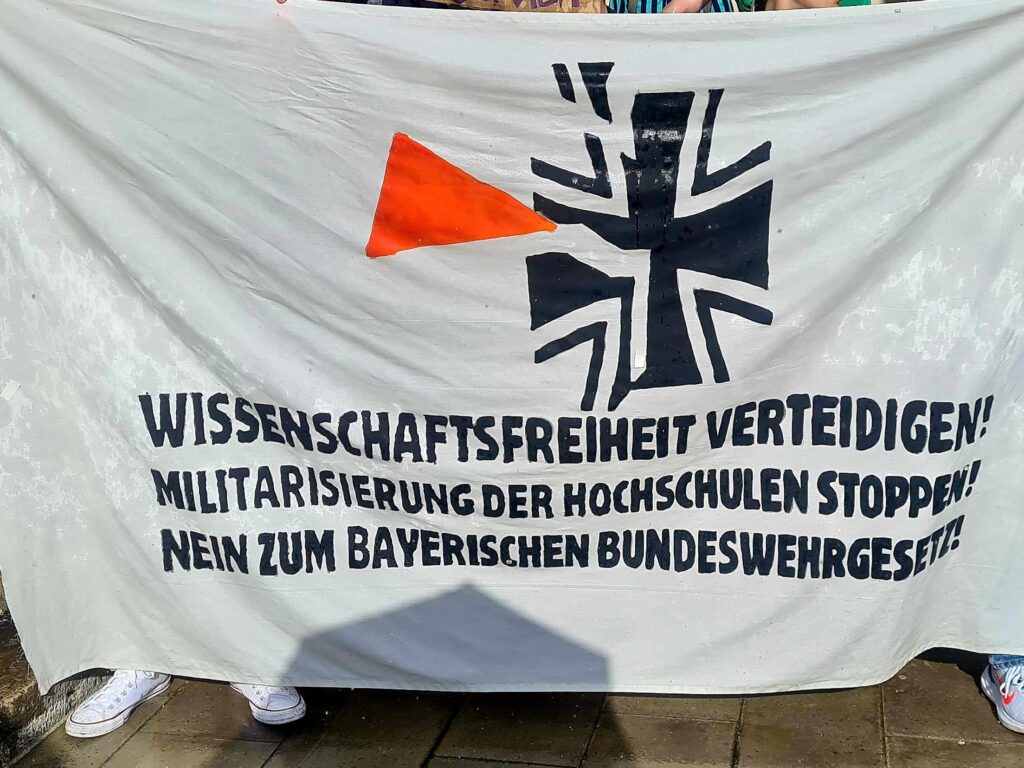
Class-Action Lawsuit Against the Law on Support for the Bundeswehr in Bavaria
“This ruling is an important step against the increasing militarization of education and science. Universities must be able to decide for themselves whether and to what extent they enter into partnerships—state coercion in this regard is incompatible with the freedom of research and teaching and the obligation to promote peace enshrined in the Bavarian Constitution.” (Maria R. Feckl, spokesperson for the DFG-VK Bavaria)
Class-Action Lawsuit Against the Law on Support for the Bundeswehr in Bavaria
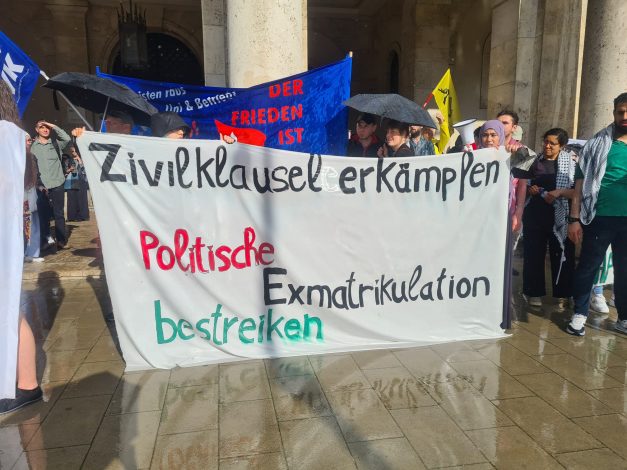
Ruling of the Bavarian Constitutional Court of March 3, 2026—A Partial Victory
With the ruling of the Bavarian Constitutional Court on March 3, 2026, the DFG-VK Bavaria, together with the GEW Bavaria, achieved an important victory. Although the popular action was only partially upheld, However, it was successful on one key point: the legal obligation of universities to cooperate with the Bundeswehr was declared unconstitutional. This rejected the most serious infringement of the law and sent an important signal in support of academic freedom and the rule of law. This success would not have been possible without the commitment of many supporters. Around 200 people from academia, education, labor unions, the peace movement, and civil society jointly supported this lawsuit.
For a world in which people can live without coercion, violence and war.
“We regret that the court continues to allow schools to be required to host appearances by Bundeswehr youth officers. Overall, however, the decision represents a major success because it strengthens academic freedom and ensures that universities cannot be legally compelled to cooperate with the Bundeswehr.” ( Martina Borgendale, State Chair of the Education and Science Union (GEW) in Bavaria)
What remains unresolved?
No objections were raised to the regulations governing Bundeswehr youth officers in schools or their participation in career guidance activities. Likewise, the ban on “civil clauses” remained in effect. Although the court has declared these regulations to be constitutional, the associated social and educational policy issues are by no means resolved.
Rather, a new phase of the debate is now beginning
The experiences of the past few months have shown that, far beyond the specific lawsuit, there is great interest in collectively exploring issues of academic freedom, education, democracy, and peace policy. For scholars, the question arises as to how the freedom of civilian research can be practically safeguarded and further developed in the future. For students, the question arises as to what opportunities for democratic participation exist at universities when decisions are made regarding collaborations with military institutions. For teachers, parents, and students, the challenge remains to ensure a political education that highlights diverse perspectives and fosters critical thinking.
“Numerous scholars and academic institutions can breathe a sigh of relief: even in the future, Science Minister Blume will not be able to simply dictate what they should research and for whom. Blume denigrated the defenders of academic freedom as ‘naive moral pacifists.’ However, the court’s decision now exposes his policies—and those of the state government—as pure populism at the expense of the integrity of the Bavarian Constitution.” ( Eduard Meusel, spokesperson for the Higher Education and Research Section of GEW Bavaria)
Possible Next Steps
A wide variety of approaches are conceivable:
• scientific statements and voluntary commitments for civilian research
• Discussions and resolutions in academic bodies
• Initiatives by student councils
• Activities by parent and teacher associations
• Documentation and critical monitoring of Bundeswehr events at schools
• Support for students who wish to exercise their right to balanced political education
Conclusion
This also raises the question of how academia, education, culture, labor unions, and civil society can engage more effectively with one another in the future when it comes to peace, democracy, and social responsibility. This is not merely a matter of individual provisions of a law. The discussion touches on fundamental issues of our time: the relationship between education and the military, the role of science in a democratic society, the significance of international law, the freedom of research and teaching, and the question of how peace, democracy, and social cohesion can be strengthened in the future.
Does anyone have any contacts or ideas?
Over the past few months, a remarkable network has emerged within our coalition. Many of you have made it clear that you would like to continue the dialogue on these issues even after the proceedings have concluded. We believe this is both sensible and necessary.
Please write to us if you have ideas for further involvement in schools or contacts at colleges and universities.
Email us at: maria.feckl@dfg-vk.de
To go with it
The GEW Bavaria press release
Class-Action Lawsuit Against the Law on Support for the Bundeswehr in Bavaria
Constitutional Court Halts Mandate for Universities to Cooperate with the Bundeswehr
A coalition of 200 plaintiffs achieved a major partial victory before the Bavarian Constitutional Court—strengthening academic freedom and the rule of law.
A broad coalition of 200 plaintiffs has achieved a significant partial victory before the Bavarian Constitutional Court. The court ruled that a key provision of the law on support for the Bundeswehr in Bavaria was unconstitutional. This halted the legislative attempt to compel universities to cooperate with Bundeswehr institutions—an encroachment that, in the court’s view, violates academic freedom as well as fundamental principles of the rule of law.
The contested passage appears in the Bavarian Higher Education Innovation Act (BayHIG), Art. 6, para. 8, sentence 2, inserted by the Act on the Promotion of the Bundeswehr in Bavaria of July 23, 2024:
“They (the universities, author’s addition) shall cooperate with them (the Bundeswehr, author’s addition) if and to the extent that the State Ministry, upon request by the Bundeswehr, determines that this is necessary in the interest of national security.”
In the opinion of the Constitutional Court, this obligation violates fundamental constitutional principles, in particular the principle of the rule of law and academic freedom.
From the perspective of the plaintiffs’ coalition, this successfully challenged the law’s most serious encroachment on the autonomy of universities. The statutory obligation would have effectively required universities to cooperate with the Bundeswehr.
Furthermore, it became clear during the proceedings that the Free State of Bavaria had also exceeded its authority with this regulation. Matters concerning the organization and functions of the Bundeswehr generally fall within the federal government’s sphere of responsibility. The attempt to establish binding requirements for cooperation between universities and the Bundeswehr through a state law therefore also undermines the principle of the rule of law, which demands strict adherence to the division of powers.

