
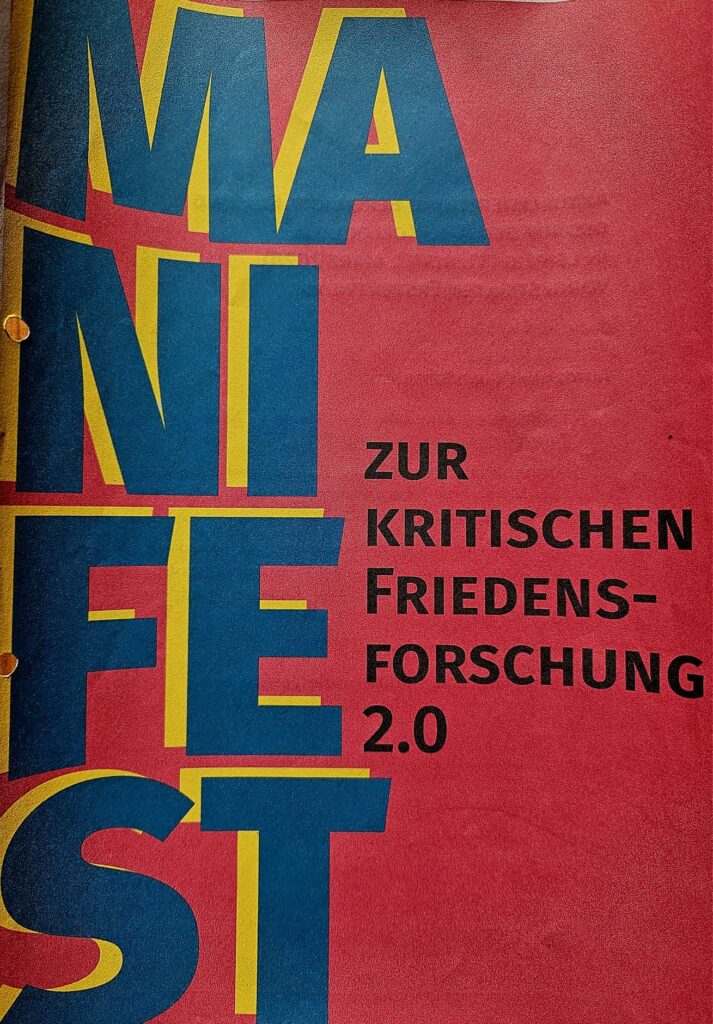
Manifesto on Critical Peace Research 2.0

Manifesto on Critical Peace and Conflict Research
Zivilklausel für bayerische Universitäten

Why Do We Need Critical Peace and Conflict Research?

Quoted from the foreword:
"The 'Manifesto on Critical Peace Research 2.0' was initiated by the working group 'Peace Research Critical of Power' within the 'Working Group for Peace , and Conflict Research' (AFK). It emerged against the backdrop of a long-standing unease regarding the direction—particularly —of that segment of peace research which appears to represent the discipline in the public sphere . Not least since Russia’s war of aggression against Ukraine in February 2022 and Israel’s genocidal war in Gaza—waged in response to the Hamas attacks of October 2023—the verdict has been: too pro-government, too uncritical, too security-focused. With this approach, the distinctions from strategic and security studies risk becoming blurred—studies whose epistemological stance and practical recommendations peace research originally set out to challenge."
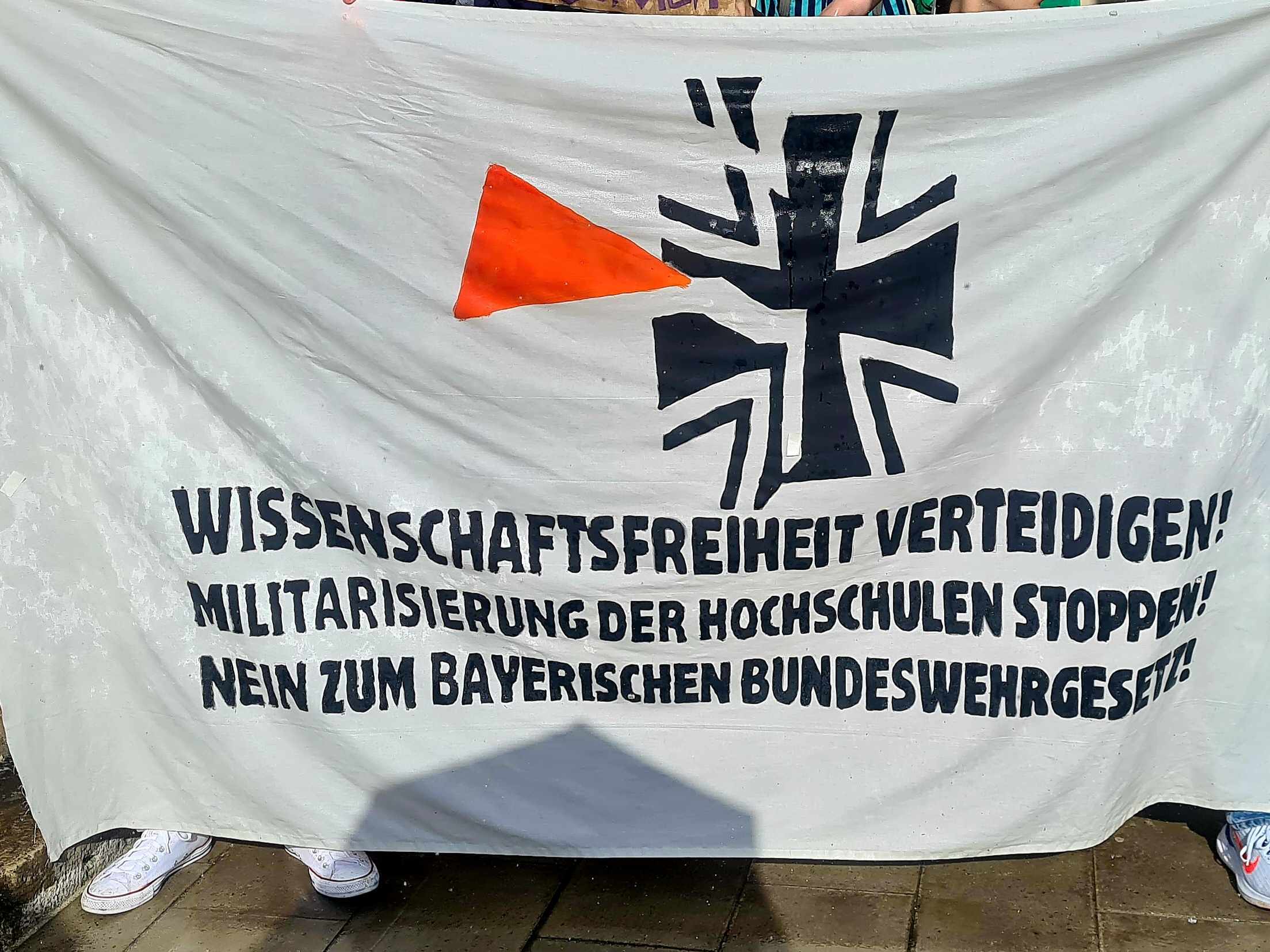
In light of recent attacks on academic freedom

"Furthermore, a heated controversy erupted at the AFK general meeting in March 2025 regarding how political the statements of a scientific umbrella organization may be in light of the current attacks on academic freedom . This tangible dissent reinforced the desire to positively shape our own vision of a different, more critical approach to peace research . However, since the idea of a manifesto had already been circulating, the project was able to gain momentum as early as April 2025 with an initial draft and the formation of a writing and editorial team (consisting of Sabine Jaberg, Philipp Lottholz , and David Scheuing). From then on, the topic was a constant feature at the monthly AK meetings."

“Especially now, at a time of wars around the world and unchecked military buildup in Germany, the scientific community must advocate for an end to violence and conflict and must not submit to the canon of nationalism and militarism.”
(Maria R. Feckl, DFG Regional Committee of Bavaria, responds to an inquiry from the AZ)

In the tradition of the 1971 Wannsee Declaration on Critical Peace Research

"Even though the manifesto originated from the Working Group on Peace Research Critical of Power Structures (AK Herrschaftskritische Friedensforschung) and was published by it, it is not limited to perspectives that are explicitly critical of power structures —perspectives that nonetheless leave their mark on the text . This made it possible both to continue the tradition of the 1971 Wannsee Declaration on critical peace research and to include other AFK working groups in an equal process of discussion and drafting . A milestone was the commentary conference held online on January 16 and 17, 2026, to which we had extended invitations both via to the working groups and through the AFK newsletter. The draft, revised in light of the discussions held there, was distributed in print form at the AFK Colloquium in Leipzig from March 11 to 13, 2026 and, above all, was the subject of intensive discussion during a dedicated panel session."

Excerpts from "The Manifesto - In a Nutshell"

"Critical Research – Critical Peace Practice

Critical peace research, as we understand it, establishes many connections to peace practice . In this regard, it is more permeable in both directions than is the case with traditional academic perspectives . As a committed discipline, it cannot stand apart from its subject matter but is woven into its development. Its advocates are also committed, whenever possible, to working beyond teaching and research to practically overcome societal power structures of violence. In this regard, critical peace research aligns with critical peace education as a theory of critical peace education. Both view each other as providers of peace-related knowledge that mutually complements and enriches one another. In the face of anticipated opposition, they are equally reliant on attitudes of epistemic resistance and on solidarity-based structures."

"Principles of Critical Peace Research"

We view critical peace research as characterized primarily by the following principles:
(1.) Scientific rigor and transdisciplinarity,
(2.) Openness of knowledge and a critique of epistemic violence,
(3.) Openness to theory and a sense of ongoing inquiry,
(4.) An understanding of peace studies as a transformative and interventionist discipline,
(5.) A fundamental critique of violence, as well as
(6.) A commitment to ideals of peace.

MANIFESTO ON CRITICAL PEACE RESEARCH 2.0

The full version of the manifesto is available for download on the website of the AFK’s Working Group on Critical Peace Research.

Ideals of Peace

"- The fundamental critique of violent power relations in general—and power relations in particular—is also fueled by a utopian excess of an ideal of peace, which in turn must itself be subject to critique. This constructive orientation toward the ideal of peace is also necessary for primarily critical peace research in order to articulate the normative content of its aspirations, distill criteria for its critique, and guide peace practice.

- Critical peace research is committed to a broad and positive understanding of peace .

- Critical peace research acknowledges the diversity of conceptions of peace and does not standardize their use. However, it is capable of exposing and critiquing the legitimization of violent power relations through discursive “markers of peace.”"

To go with it

the article by Alexander Spöri in the AZ dated July 7, 2026

“All in the Name of Peace”

“Bavaria’s universities have formed a research alliance. Some see this as cutting-edge conflict and security research. Others wonder whether science is being put at the service of military buildup.”

Scroll to Top

Stay in contact with us with our Newsletter

We do not send SPAM! Please check our Privacy Policy.